
Purpose: Learn how to create return rules to automate your return process, control which items customers can return, set return fees, and define return options based on specific conditions.
Related articles
→ How to set up your return portal
→ How customers can make a return
→ How to process your return shipments
Before you start
Return rules can be used with the Return Portal and Returns API v3. To use return rules in the Return Portal, your Return Portal must first be activated.
To set up your Return Portal, see How to set up your return portal.
Enable return fees and return options
Some return rule actions depend on your Return Portal settings. For example, if you want to use return rules to adjust return fees or shipping options, you must first configure those settings in the Return Portal.
- Go to Returns > Return Portal
- Enter a default return fee, if you want to charge customers for returns
- Select the return methods you want to offer
- Enable the carriers or shipping options customers can use for returns
- Click
Save
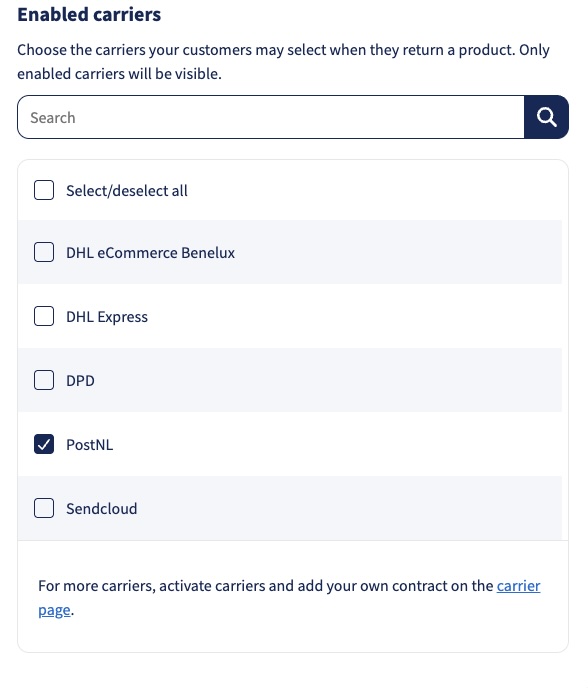
Important: If no return fee is configured in the Return Portal settings, return rules related to Return fee may not be applied.
How can I use return rules?
Return rules automatically apply an action, like a fee or a blocked item, whenever a return matches conditions you set. If you've used shipping rules before, the logic is the same.
A single condition, such as From country or Return reason, can check for multiple values at once. For example, one From country condition can cover several countries, so you don't need to create a separate rule for each country or reason.
Any condition with an in or not in operator supports multiple values in one rule, not just From country and Return reason. See the conditions and actions table for the full list.
You can use return rules to:
- Control which items customers can or cannot return
- Define from which countries customers are allowed to return items
- Apply specific return options for specific countries
- Charge different return fees based on return conditions
- Skip the image upload step for specific return reasons
- Control which refund methods (money back, store credit, items exchange) are available for specific returns
- Automate return behavior for both Return Portal and Returns API v3 flows
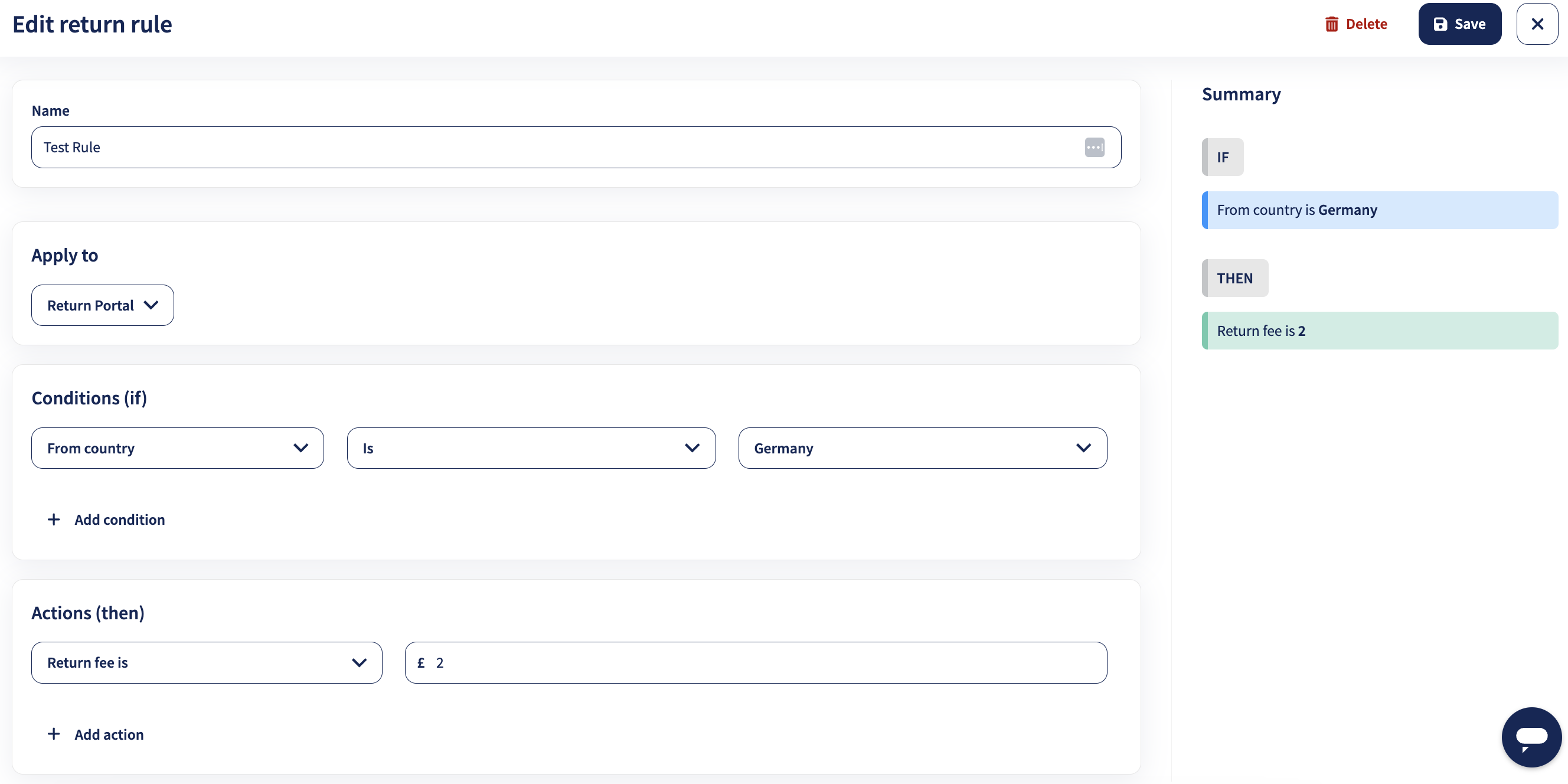
In the example below, the return rule displays a €2.00 return fee in the Return Portal or Returns API v3, but only for returns from Germany:
Further down this article, you can find example return rules you can use as inspiration.
Set up your return rules
- In your Sendcloud account, go to Returns > Return Rules.
- Click
Create new return rule. - Give your rule a clear Name. Choose a name that explains what the rule does, for example Free returns for Germany or Block pajamas from returns.
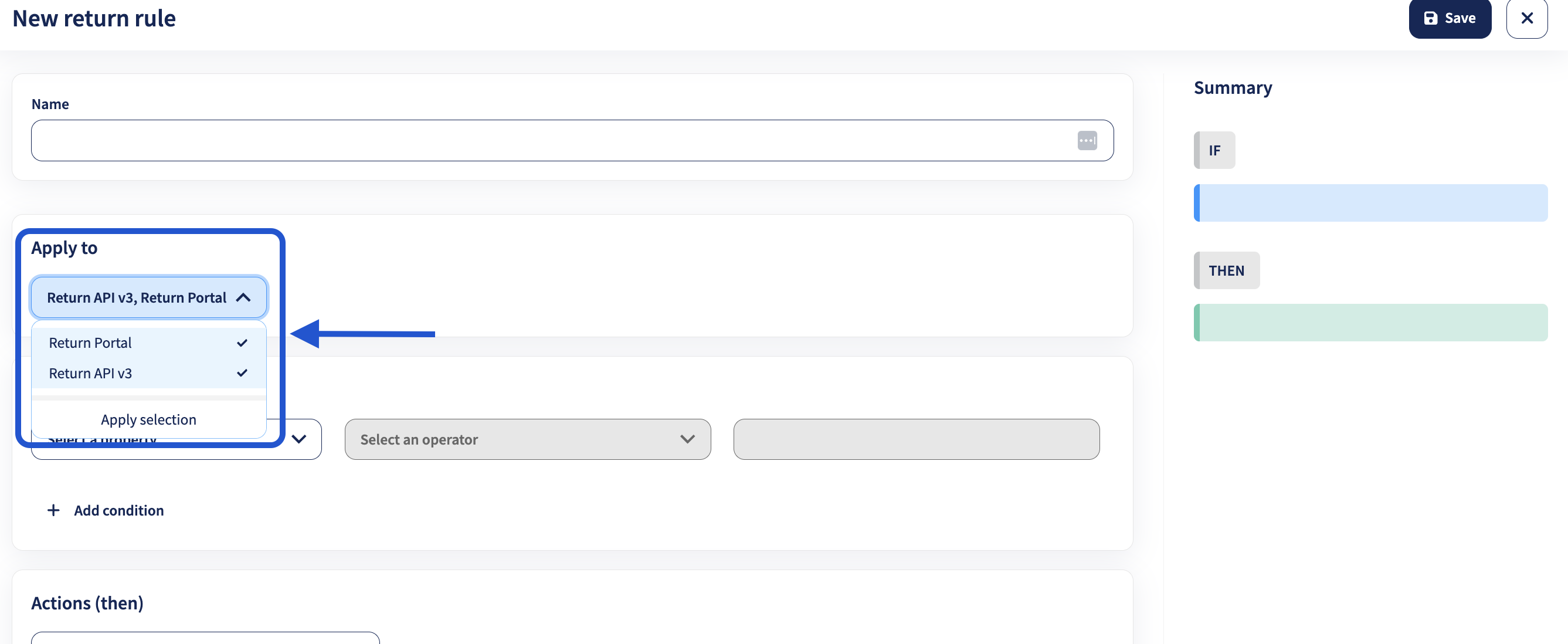
- Choose where the rule should apply in the Apply to field:
- Return Portal – The rule applies only to returns created through the customer-facing Return Portal.
- Returns API v3 – The rule applies only to returns created through the API.
- Both – The rule applies to all supported returns, regardless of how they are created.
- Choose an IF condition, such as From country, Return reason, or Item name.
- Choose the operator, such as is, is not, contains, or in. For From country and Return reason, choosing in (or not in) lets you select multiple values in the same condition, for example Germany, Austria, and Belgium in a single From country condition.
- Enter the value the rule should check for, for example Germany. If you chose in or not in, select as many values as you need from the list.
- Choose the action that should be applied, for example Return fee is.
- Click
Save return rule.
Example:
Rule 1 (top): IF From country IS Germany THEN Return fee is €5.00
Rule 2 (bottom): IF Weight (kg) IS Greater than 0 THEN Return fee is €0
Result: German returns get €0, not €5.00, because rule 2 matches every return and sits below rule 1, so it takes effect.
Manage existing return rules
From the Return Rules overview, you can:
- Edit an existing rule by clicking the
⋮menu - Change the order of your rules using the arrows
- Activate or deactivate rules by toggling them on or off
Changes to return rules apply only to future returns. They do not affect returns that have already been created.
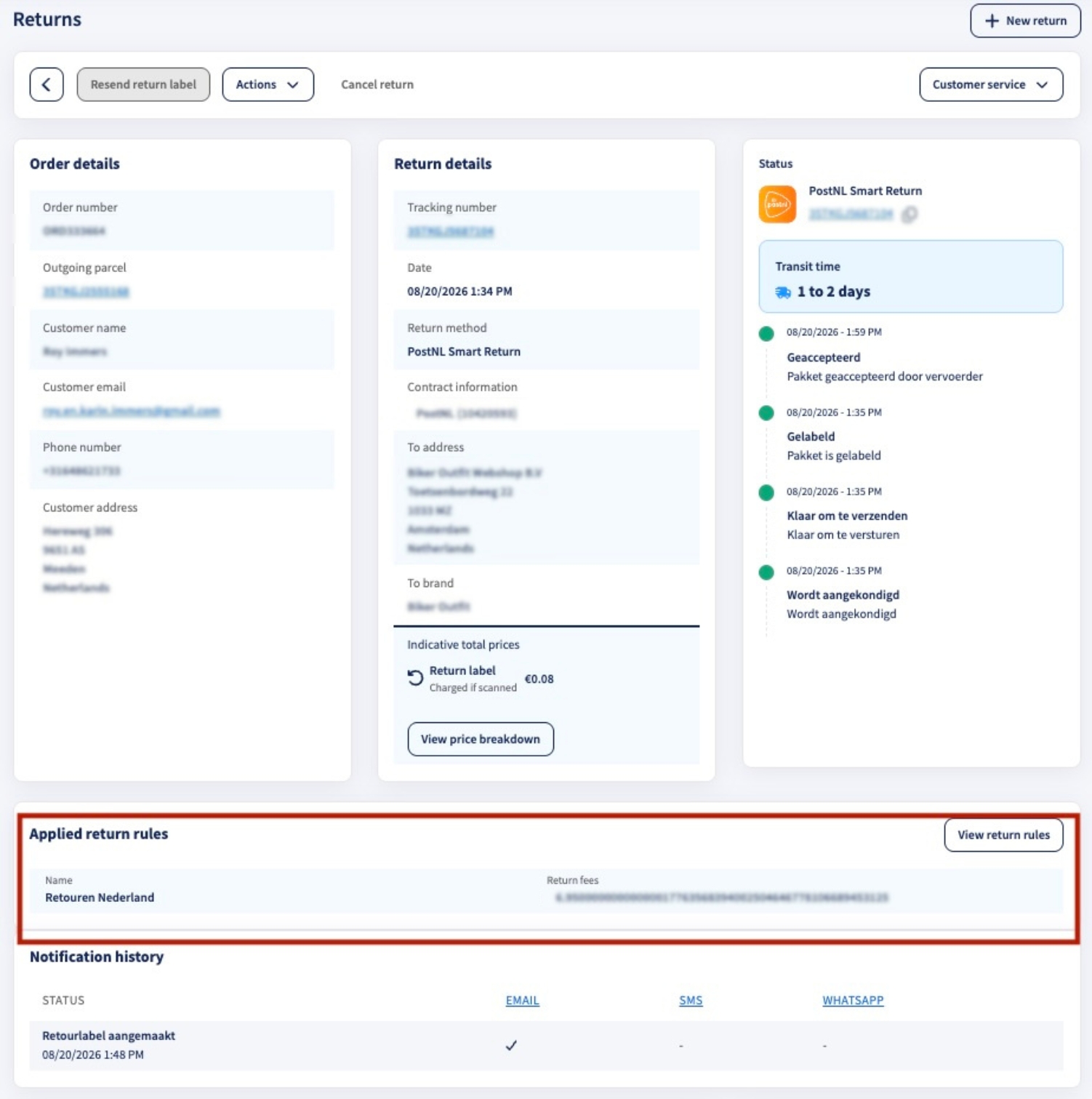
How can I see if a rule has been applied to a return?
You can see whether a return rule has been applied by opening the return details view.
Return rule conditions and actions
You can choose from the following conditions when setting up a return rule:
| Condition: | Operators: | Explanation: |
| Brand | Is/Is not | The brand associated with the order, for merchants managing multiple brands. Select the brand from a list. |
| From country | Is/Is not/In/Not in | The country the customer is returning the item from. Use in or not in to check for multiple countries in one condition. |
| From postal code | Is/Is not/Contains/Does not contain/Starts with/Ends with/Pattern match/In/Not in | The postal code the customer is returning the item from. |
| Integration | Is/Is not | The shop integration the order was imported from. Select the integration from a list. |
| Item name | Is/Is not/Contains/Does not contain/Starts with/Ends with/Pattern match/In/Not in | The name of an item in the return. |
| Item property | Is/Is not/Contains/Does not contain/Starts with/Ends with/Pattern match/In/Not in | A custom item property (such as size, colour, or a custom attribute) set on shipments created via API v2. Enter the property name, then choose the operator and value to check for. |
| Item SKU | Is/Is not/Contains/Does not contain/Starts with/Ends with/Pattern match/In/Not in | The SKU of an item in the return. |
| Refund type | Is/Is not | The refund type the customer selected: money back, store credit, or items exchange. |
| Return carrier | Is/Is not | The carrier used for the return. Select the carrier from a list. |
| Return order value | Is/Is not/Less than/Greater than/Greater or equal than/Less or equal than | The total value of the order being returned. |
| Return reason | Is/Is not/In/Not in | The reason the customer selected for the return, from the return reasons configured in your Return Portal. Use in or not in to check for multiple return reasons in one condition. |
| Weight (kg) | Is/Is not/Less than/Greater than/Greater or equal than/Less or equal than | The weight of the return shipment in kilograms. |
You can set the following actions:
| Action: | Explanation: |
| No approval required for this return request | If your Return Portal is set up to require manual approval before a return is accepted, this action skips that approval step for returns matching the rule's conditions, they're accepted automatically instead of waiting for you to approve them. |
| Refund methods are | Sets which refund methods (money back, store credit, items exchange) are available for returns matching the rule's conditions, overriding the refund methods configured in your Return Portal settings. This is a multi-select action, so you can allow more than one refund method. Exchanges are not available for Shopify orders, even if configured through a return rule. |
| Return address is | Sets which return address is used, from the return addresses set up in your account settings. |
| Return fee is | Sets the return fee for returns matching the rule's conditions. |
| Set return period to | Sets the return period in days (maximum 365 days) for returns matching the rule's conditions. |
| Ship with | Preselects a shipping option for the return label. Only one shipping option can be selected per return rule. |
| Skip image upload | Only relevant if Return Requests is enabled. This action waives the image upload for items matching the rule's conditions. In a multi-item return, if only some items match, the upload is skipped for those items only; if every item in the return matches, the upload step is skipped for the whole return. |
| Unable to return item | Blocks a specific item from being returned. |
| Unable to return order | Blocks the entire order from being returned. |
| Use shipping contract | Applies a specific carrier contract to the return. |
Important: The Refund methods are action applies per order, not per item. Return rules are applied from top to bottom, so if more than one rule with a Refund methods are action matches the same return, the rule furthest down the list determines the refund methods for the whole order.
Example return rules
Below are examples of common return rules you can create. You can adapt these examples based on your own return policy.
Charge return fees depending on the return country
Use the in operator to charge the same fee for a whole group of countries in one rule, instead of writing a separate rule per country:
IF From country IN [Germany, France, Spain, Italy, Austria] THEN Return fee is €6.95
Two rules cover a whole zone of countries, instead of one rule per country.
If you want a different fee per individual country instead of one flat rate for a group, use separate rules with is or is not:
IF From country IS Germany THEN Return fee is €5.00
Important: Return rules are applied from top to bottom. If more than one rule matches the same return, the rule furthest down the list takes effect.
Set a return fee based on the return reason
You can use return rules to make returns free for specific return reasons. For example, if the customer received the wrong product, you may want to waive the return fee.
To waive the fee for several reasons at once, use the in operator instead of creating one rule per reason:
This waives the fee for every reason that reflects an error on your side, in a single rule. You can use the same approach the other way around, for example to charge a fee for reasons that aren't your responsibility:
Combine multiple countries and reasons in one rule
You can combine an in condition on From country with an in condition on Return reason in the same rule, using AND:
This charges the fee only when both conditions match: the return is from one of the three countries, and the reason is one of the two listed, all in a single rule instead of several.
Skip the image upload step for specific return reasons
This only applies if Return Requests is enabled. This rule waives the upload for items with these reasons, keeping proof of condition in place for reasons you actually want to review, such as damage or faulty items. If a return has multiple items and only some of them match the rule, only those items skip the upload; the rest still need a photo.
Prevent specific items from being returned
Use this rule if some items are excluded from your return policy, such as personalised, customised, or hygiene-sensitive products.
Prevent an order from being returned if it contains a specific item
Use this rule if the presence of one specific item should block the full order from being returned.
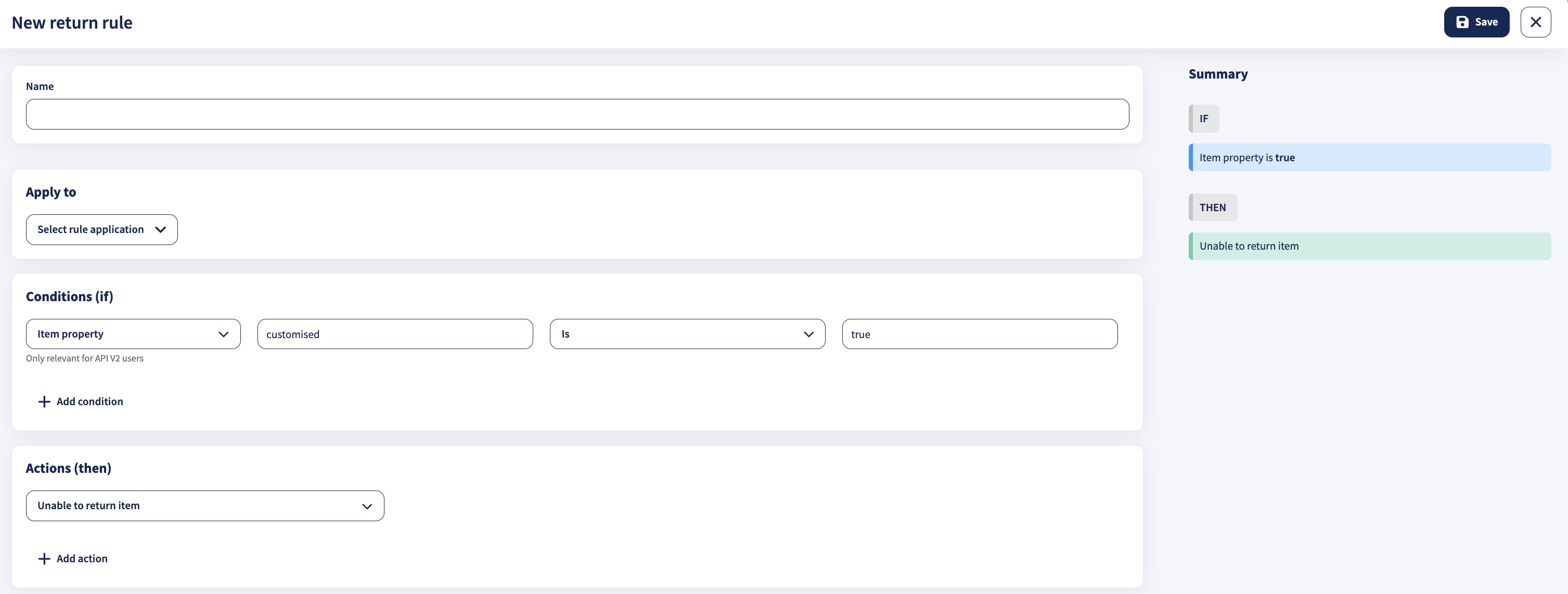
Use item property-based return rules
Important: This return rule is only available for shipments originally created via API v2. Using API v2, you can indicate item properties for outgoing shipments. These properties can then be retrieved for returns processed through the Sendcloud Return Portal.
You can create return rules based on item properties such as size, colour, or custom attributes. For example, you can prevent returns of customised products.
-
True/False values: Not case-sensitive. For example,
trueandTrueare treated the same. -
Other values: Case-sensitive. For example,
blueandBlueare treated as different values.
Some shop integrations import item properties, but this is not guaranteed for all integrations.
Set available refund methods for specific returns
Use this rule to limit which refund methods are offered for returns matching the rule's conditions, overriding the refund methods configured in your Return Portal settings. For example, you can offer all refund methods in one country while limiting returns from another country to money back and store credit only.
You can also use this action to steer customers away from a money-back refund and toward an exchange or store credit for specific return reasons.
You can also base the available refund methods on the order's value, rather than the return's country or reason.
Promote item exchange by assigning return fees to refund types
IF Refund type IS Items Exchange THEN Return fee is €0
IF Refund type IS Store Credit THEN Return fee is €0
You can use this setup to encourage exchanges or store credit by charging a return fee only when the customer chooses a money-back refund.
Ship with a specific carrier contract depending on the brand
If you manage multiple brands or return addresses, you can use return rules to apply a specific carrier contract to returns from a selected brand.
Prevent returns from specific countries
Use this rule to block returns from countries that are outside your return policy.
To block several countries at once, use the in operator instead of creating a separate rule for each country:
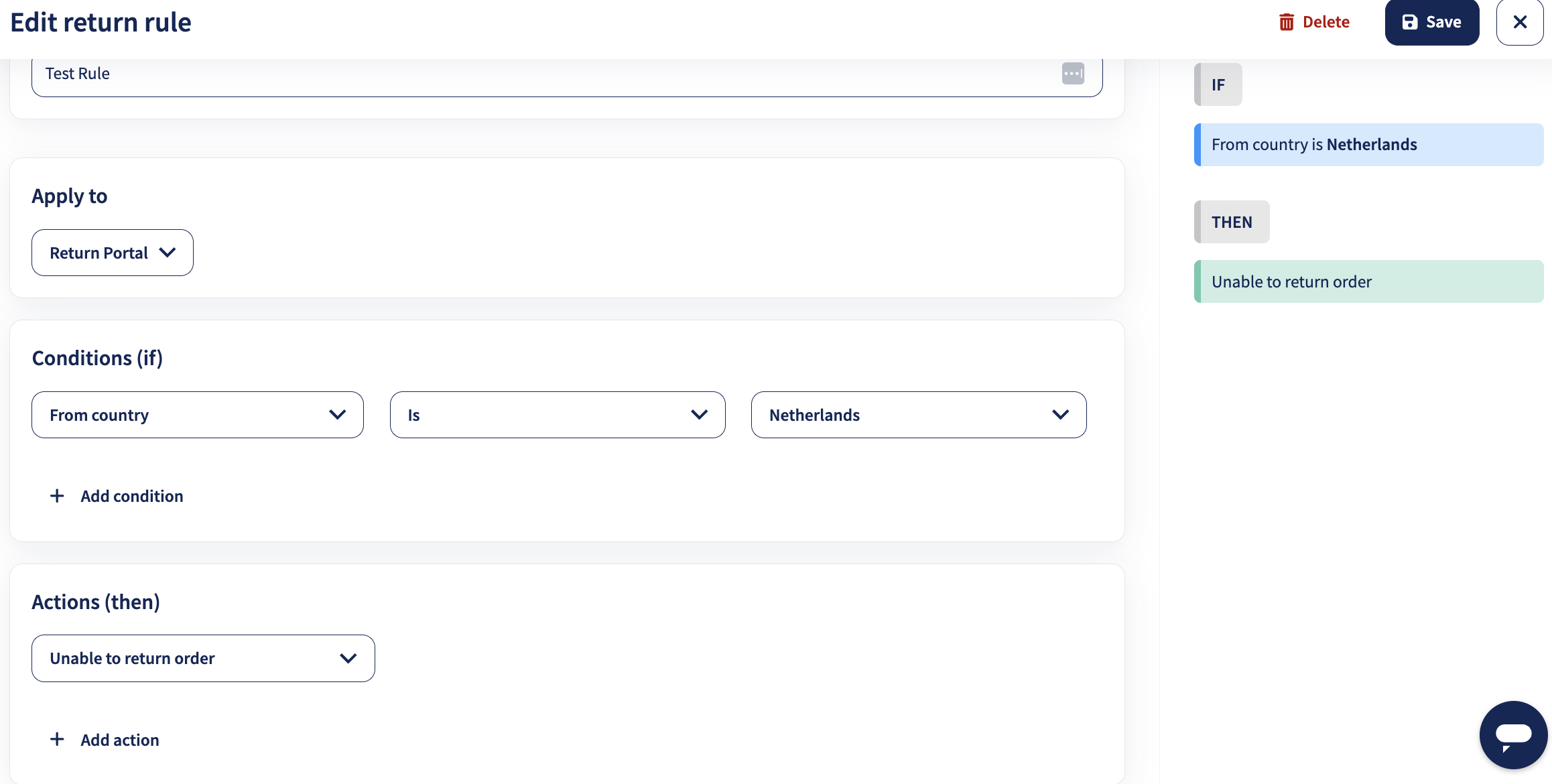
If a customer tries to return an order from a blocked country, they will see an error message.
Block specific items from being returned from specific countries
When using multiple conditions, combine them with AND if the rule should only apply when all conditions are met. Using OR may cause the rule to apply more broadly than intended.
Use a specific carrier for returns from a country with limited return options
Not every return option supports every country. For example, if your Return Portal offers a QR code (labelless) return option, this isn't supported for returns via Royal Mail. If you want to offer QR code returns generally but still need a working return option for customers returning from the UK via Royal Mail, use a Ship with rule to preselect a supported option for that country.
Ship with a specific return shipping option per country
Note: The Ship with return rule now works with shipping options. Existing rules based on the previous setup still continue to work and are shown in the panel as [Deprecated] Ship with method. This deprecated version remains available to avoid breaking existing return rule setups. For new configurations, use Ship with.
If you ship on your own carrier contract, you may want to preselect which shipping option customers can use for return labels. The Ship with rule lets you select a shipping option based on the From country condition.
Since From country supports the in operator, you can also apply the same shipping option to a group of countries in one rule:
When this rule is applied, the Return Portal only shows the selected shipping option to the customer. Other enabled return options will not be shown for that return.
For example, if both GLS NL and PostNL are enabled in your Return Portal settings, but your return rule specifies Ship with PostNL Easy Return, the customer will not see GLS NL as an option.
Things to know about the Ship with rule:
- The available shipping options are based on the carriers you enabled in the Return Portal settings.
- You must enable the relevant return option in your Return Portal settings.
- You can select only one shipping option per return rule.
- The rule applies to returns that meet the selected From country condition.
Important notes when excluding values
To exclude values, such as specific countries, use the is not or not in operator in your return rule conditions.
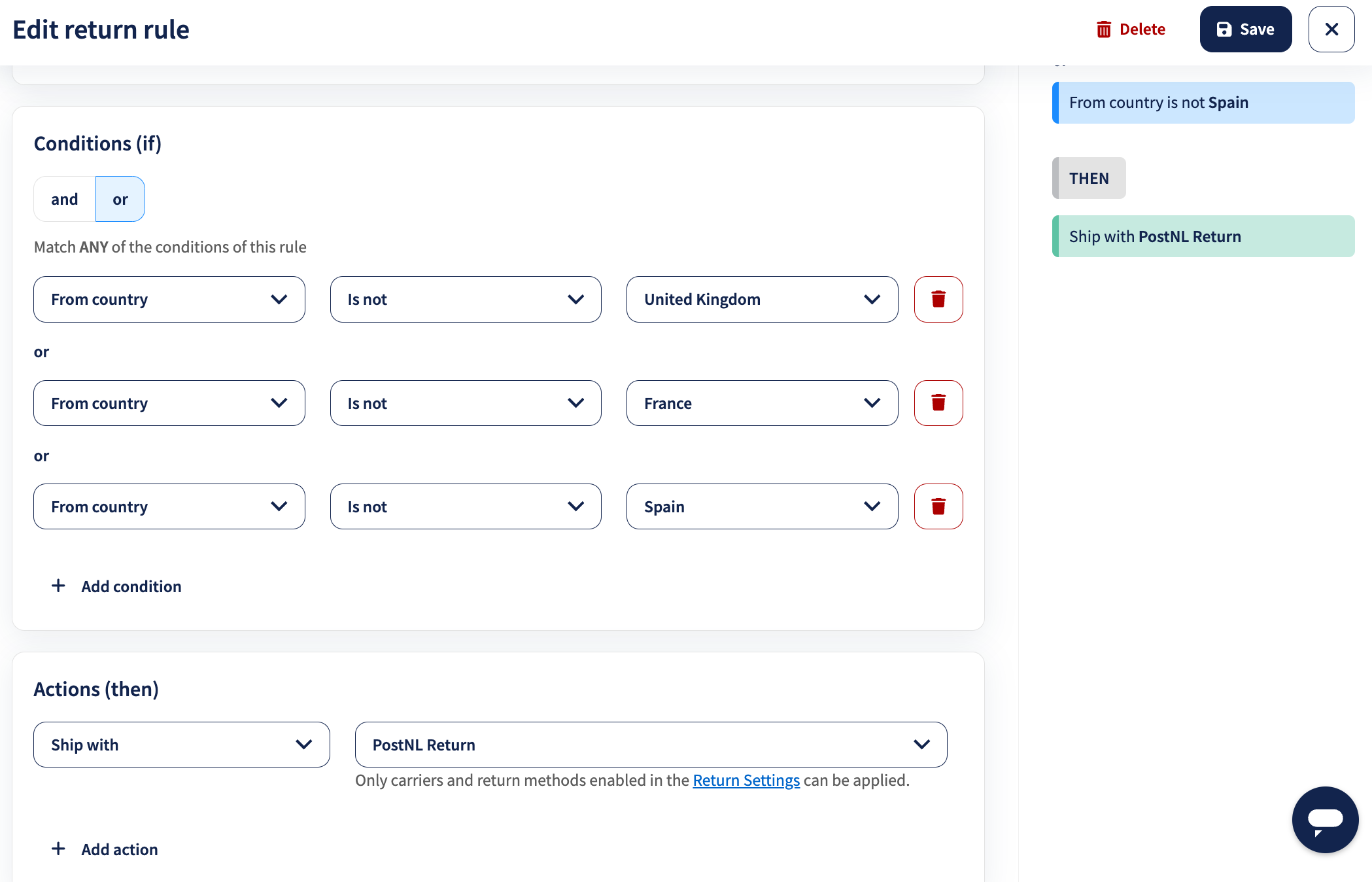
If you add several conditions, combine them with AND so the rule applies only when all conditions are met. If you use OR, the rule will be triggered when at least one condition is met, which can make the rule apply more broadly than intended.
Example: Excluding countries from a shipping option
You want to exclude France, Spain, and the United Kingdom from return shipments with PostNL Return because you prefer to use a different return option for those countries.
- If the return is sent from France, all exclusion conditions match, and the return will not be shipped with PostNL Return.
- If the return is sent from Poland, the exclusion conditions do not match, and the return can be shipped with PostNL Return.
Best practices for return rules
- Keep rules specific and easy to understand.
- Use clear rule names so you can quickly recognise what each rule does.
- Check the order of your rules, especially when several rules can apply to the same return.
- Use AND when all conditions must be met.
- Use OR only when the rule should apply if at least one condition is met.
- Test your rules before relying on them for all returns.
Return Rules API v3 and advanced setups
Return Rules can be applied to returns created through the Return Portal, Returns API v3, or both. This helps automate your return process if you manage returns through the customer-facing portal, custom integrations, or external return solutions.
When creating or editing a rule, use the Apply to field to choose where the rule should be applied.
Important notes for API users
- Return rules applied via API override manual request values if the
apply_rules: trueparameter is used in the API request. - If you use an external return solution, such as ReturnGo, check with the provider to confirm they support Return Rules API v3.
- Simply setting up rules in Sendcloud will not apply them to third-party return flows unless the provider has implemented this functionality.
For API users, include "apply_rules": true when creating a return via API to make sure return rules are applied.
How can I create a return through the Return Portal?
- Go to the Shipped tab.
- Click the eye icon next to a created label.
- In the detail view, click Actions.
- Select Create a return with the Return Portal.
Alternatively, see How customers can create a return.
What happens to my return portal and return rules if I downgrade my subscription plan?
If you downgrade from Premium or Pro to Growth, your return portal will remain active. However, Premium features such as paid returns and custom return reasons will be disabled. Your existing return rules will not be automatically modified or disabled, even if they use features that are no longer available on your plan. We recommend reviewing and updating your return rule configuration after downgrading to ensure your return process continues to work as expected.
If you downgrade from Growth to a lower plan, your return portal will become inactive. Your existing return rules will remain saved in your account, but they cannot be enabled unless you upgrade to a plan that includes the return portal.